
Laser cutting is ideal for complex, low-volume designs due to its digital flexibility, while punching excels at high-volume production of repetitive, formed parts because of its mechanical speed and lower per-unit cost.
I’ve spent years on the factory floor helping shops solve the “laser cutting vs. punching” dilemma. I have seen thousands of dollars wasted on the wrong equipment. Most fabricators feel paralyzed by technical jargon and machine specs. The truth remains simple. You do not need a mechanical engineering degree to make the right choice. You only need to understand how these machines impact your bottom line.
Why Should You Look Beyond Machine Specs?
If you search for “laser cutting vs. punching,” data quickly buries you. Articles discuss gigawatts, tonnage, and shear stress. This technical overload makes fabricators believe cutting metal requires a doctorate in physics. Do not let the technical talk fool you.
Machine specs cause unnecessary overthinking. Fabricators often compare top travel speeds or laser wattage, but these metrics mislead buyers. The most effective machine is rarely the one with the flashiest brochure. Generally, the right machine is the one that finishes your specific part at the lowest unit cost.
Ask yourself one central question: Are you manufacturing a unique, one-off prototype, or are you running a thousand identical brackets every week? Your production volume and geometry dictate the answer. Physics inside the machine does not dictate the answer.
How Do Laser Cutting and Punching Work?
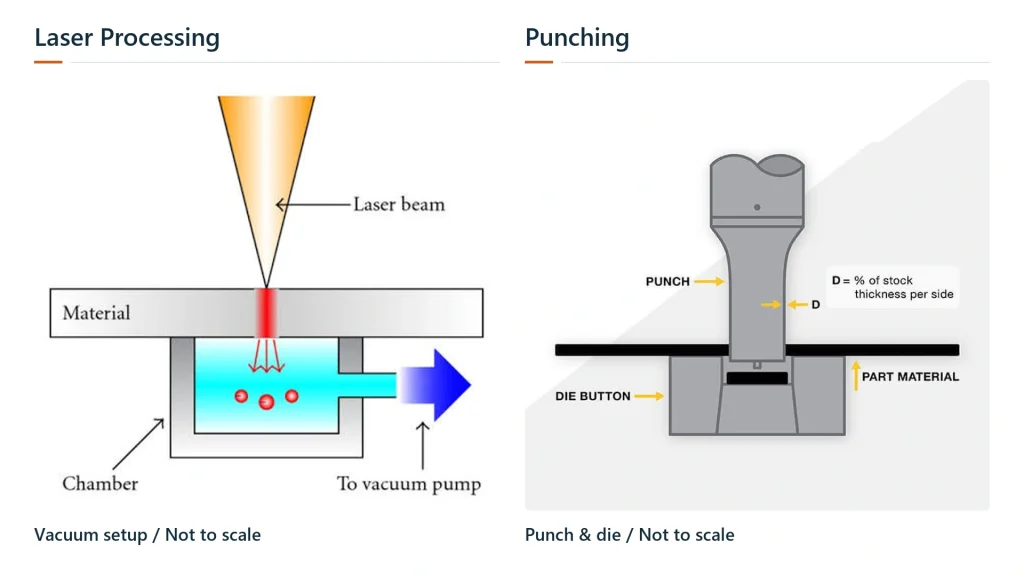
Laser Cutting: The Thermal Process
A laser cutting system functions as a precision digital paintbrush. A concentrated, high-powered beam melts or vaporizes metal along a programmed toolpath. Because computer software directs the beam, the laser accommodates any profile. You can produce simple squares, intricate logos, and organic contours in a single program.
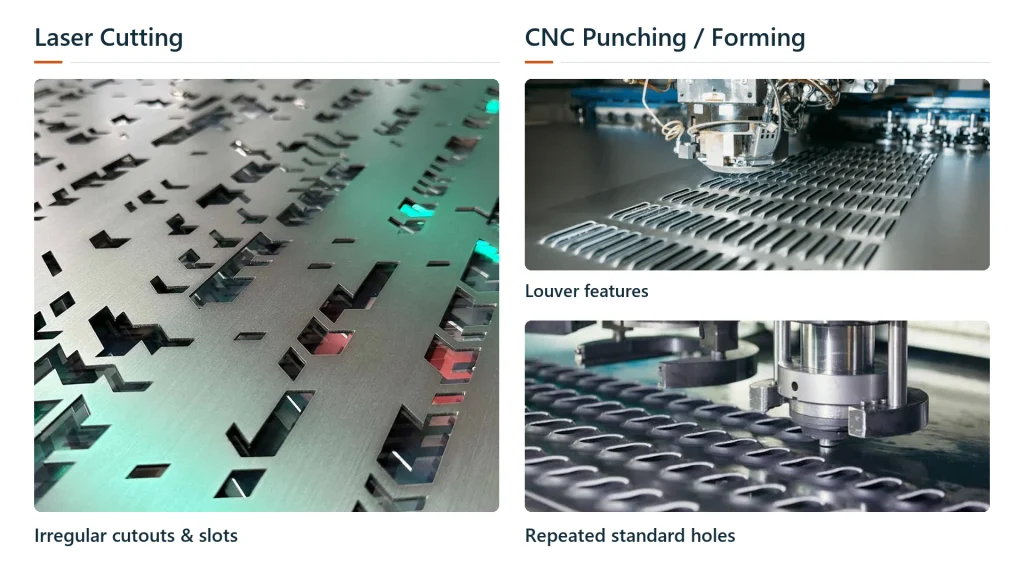
- Capabilities & Advantages: It handles complex contours with high precision. It produces clean edge quality, often eliminating secondary grinding. It requires significantly less physical tooling, making it the king of design flexibility.
- The Thermal Reality: Laser cutting is a thermal process. Laser cutting can create a Heat-Affected Zone (HAZ), whose extent depends on the material, heat input, cutting speed, and thickness. TWI explains these HAZ effects. A conventional flatbed sheet laser cuts profiles; it does not itself perform forming operations such as bending or embossing.
Punch Pressing: The Mechanical Process
A punch press acts as a high-speed mechanical athlete. It uses hydraulic, mechanical, or servo force to drive hardened steel punches through sheet metal into matching dies.
Mechanical punching excels at high-volume repetition. As TRUMPF explains in its guide to punching and nibbling, punching suits repeating shapes, while nibbling uses overlapping strokes to create contours. For sheets with hundreds of identical perforations, compare the actual cycle times using the proposed tooling and machine.
- Capabilities & Advantages: It delivers rapid cycle times during mass production. With suitable tooling and machine capability, it can also produce formed features such as louvers, countersinks, knockouts, and dimples.
- The Limitations: Your tooling library dictates your capability. Custom geometries require dedicated, expensive tooling. Over time, physical punches wear down and demand regular sharpening to maintain part quality and prevent burr formation.
The Hidden Costs: Beyond the Sticker Price
Machine purchase price represents only part of your capital investment. Hidden operating expenses frequently determine your real profitability.
Setup Time vs. Tooling Costs
Never evaluate cutting speed in isolation. Measure the setup time before cutting begins. High setup times can reduce shop floor profitability. Shorter changeovers can improve the availability component of overall equipment effectiveness (OEE). Vorne’s OEE calculation guide counts changeovers as planned stops and defines OEE as Availability × Performance × Quality.
- Laser Setup: Lasers require minimal mechanical changeover. The operator loads a nesting file, confirms material thickness, and starts the program. This efficiency makes laser cutting a compelling choice for short-run prototypes.
- Punch Setup: Punches demand physical changeovers. The operator must install correct dies, align turret stations, check clearances, and inspect cutting edges. Setup labor represents a negligible cost for 50,000 parts, but setup time consumes your profit margin for 10-piece runs.
Hidden Labor Costs and Skill Profiles
Operator skill profiles dictate different labor requirements and shop costs:
- Digital/Laser Roles (Software-Centric):
- Reviewing CAD models: Managing complex nesting software to optimize sheet usage.
- Process Control: Calibrating gas pressures and beam focus parameters to match specific alloys.
- Digital Troubleshooting: Resolving controller errors and software-based pathing issues.
- Mechanical/Punching Roles (Tool-Centric):
- Tooling Precision: Measuring tool clearance to ensure clean shearing without distortion.
- Maintenance: Lubricating turrets and monitoring punch wear to maintain cycle speed.
- Physical Setup: Manually aligning stations and sharpening tool steels to prevent galling.
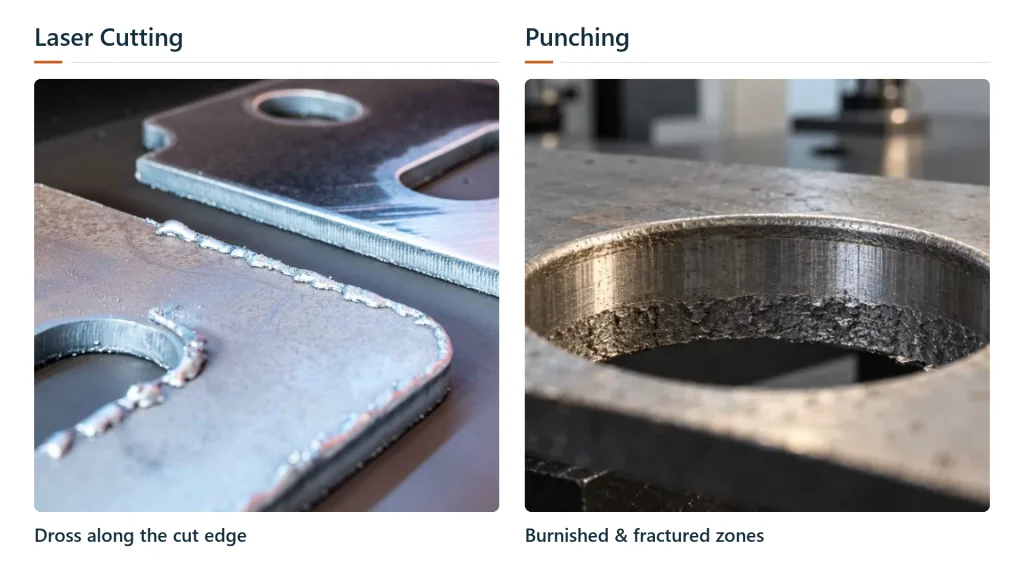
At ShincoMetal, a precision sheet metal fabrication shop based in Dongguan, Guangdong, we learned this distinction the hard way. During a high-volume batch project, our team prioritized laser cutting speed. We failed to budget for the secondary manual deburring required on the laser dross. That “fast” cutting process created a labor bottleneck that erased our profit margin.
The takeaway: Measure true “dock-to-stock” time—from raw sheet intake to finished, ready-to-ship parts.
Secondary Operations and Scrap
A low cutting cost creates an expensive finished part if secondary finishing is required.
- Edge Finishing: Laser cutting can produce smooth, square edges, but it does not guarantee that grinding or deburring can be skipped. TWI’s discussion of laser cut quality identifies edge roughness, squareness, HAZ, and dross as relevant checks; its CO₂ and Nd:YAG examples illustrate these principles rather than current fiber-laser specifications. Punched edges can also require deburring, depending on tool condition, clearance, material, and the specified edge quality.
Strategy: Choosing the Right Process
The “Coffee Break” Test
You do not need complex modeling software to select the right machine. Open your CAD file and apply this visual rule:
- The “Swiss Cheese” Rule: Does your drawing feature dozens of standard holes, knockouts, or venting grids? Route it to the punch press. It drops dozens of identical holes while a laser beam is still piercing its initial start points.
- The “Artistic Contour” Rule: Does your part contain swooping curves or custom cutouts? Send it to the laser. A punch press must “nibble” those curves with overlapping hits, which accelerates tool wear and leaves scalloped, jagged edges.
At ShincoMetal, our engineering leads caution clients against prioritizing aesthetics over structural requirements. Laser cutting offers contour flexibility, while punching can incorporate formed features. Do not assume that punching alone makes a component stiffer; evaluate the material, thickness, formed geometry, and load requirements.
The Hybrid Workflow
Integrated equipment can combine both processes: TRUMPF’s punch-laser machines describes forming, thread cutting, and laser cutting in a single operation. Whether that investment is justified depends on the part mix, production volume, and automation needs.
Small and medium-sized shops can execute a manual hybrid routing strategy:
- Step 1 (Laser): Cut the complex outer boundary and non-standard internal contours rapidly on your flatbed laser.
- Step 2 (Punch/Press): Move the flat blanks to a standard single-station punch press or mechanical press to add louvers, countersinks, or tabs.
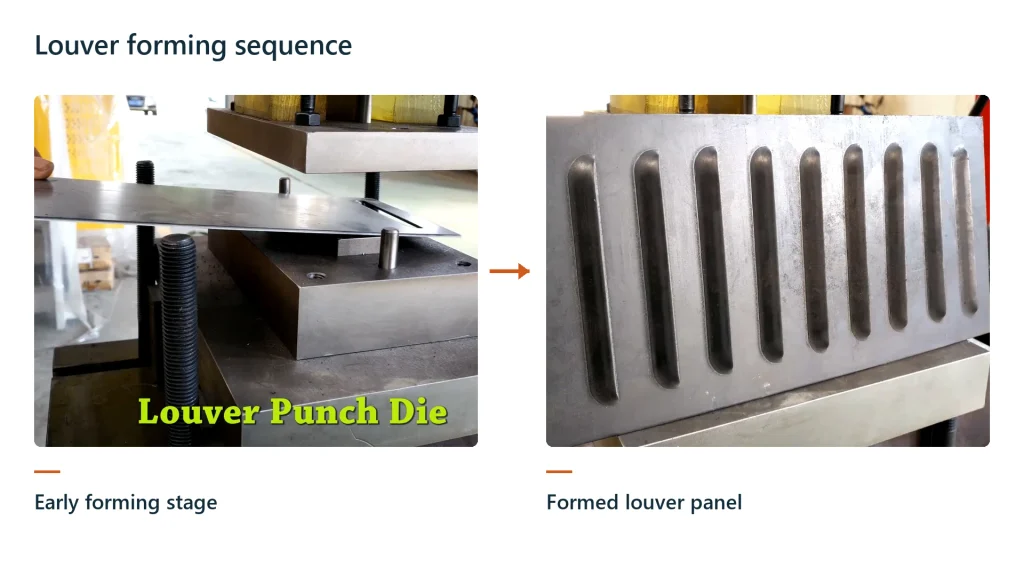
This hybrid approach may reduce the need for an integrated machine, but extra handling, positioning, and work-in-progress can offset the savings. Validate total cycle time and part accuracy before choosing this route.
Conclusion: Making the Right Fabrication Choice
Choosing between laser cutting and punching is not an expensive gamble. The decision aligns your production metric—speed, design flexibility, or unit cost—with the correct physical process.
Avoid focusing strictly on sales brochures. Base your choice on floor variables: setup turnaround, operator capabilities, scrap volume, and post-cut finishing. At ShincoMetal, our production teams in Dongguan balance these sheet metal variables daily. Audit your part geometry, evaluate your run volumes, and pick the tool built for the job.